

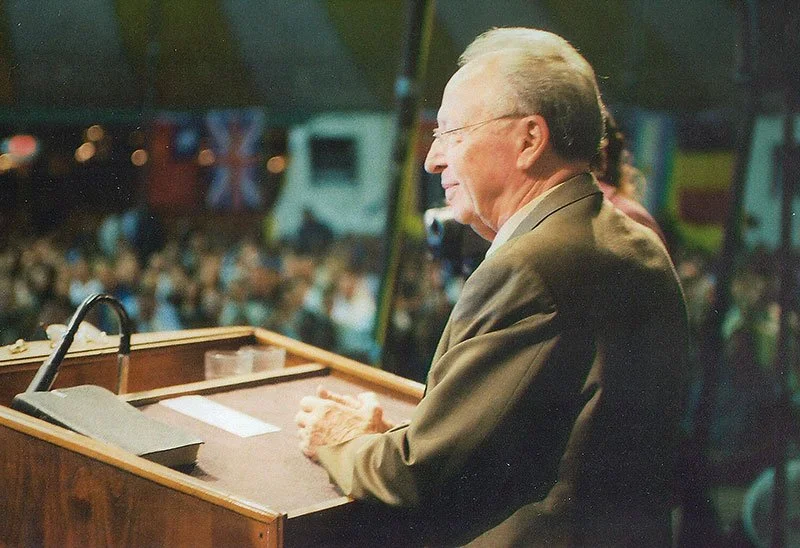
Wayman Mitchell’s vision was assembled, and The Potter’s House published the parts list. Chuck Smith held the Prescott pulpit 22 years before Mitchell took it. A drive to Southern California supplied the coffee house, the rock band and the street preaching. Oral Roberts, William Branham and A. A. Allen supplied the healing platform and the model of authority that runs on it. And in his own teaching book for pastors, Mitchell builds two core church-building principles on what he had observed in Jehovah’s Witnesses, Mormons and Jim Jones. Go Ye, An Open Door, We Can Take the Land and Helps and Guidelines record all of it. What converts heard from the pulpit was one sentence long: God gave Wayman Mitchell a vision on Easter morning in 1956, and The Fellowship was its result.
What The Fellowship Says Wayman Mitchell’s Vision Was
Go Ye, The Fellowship’s own book on discipleship and the Prescott ministry, gives the account a date. Easter morning, 1956. Mitchell had been a Christian for about two years. He was kneeling beside his bed praying for guidance when a far-reaching vision opened in front of him. He saw himself preaching in a large chapel with tiered balconies, to an audience of spiritual leaders drawn from many regions. The sermon he preached was the Great Commission of Mark 16:15. Afterward he went to his job at an aluminum plant, knowing his hand had reached for a different plow.
The second Fellowship account of Wayman Mitchell’s Vision goes further. Ron Simpkins wrote An Open Door, the 1985 history of the Prescott church, for Potters Press. He builds the same idea into a doctrine of leadership. God uses men of vision. When God has a task, He looks for a man. Prescott moved by no committee and no program, but under the vision of a man who had been touched by God. The same passage is candid about how much planning stood behind that. Many who look at the Prescott church, Simpkins writes, assume there was a master plan. In fact the work “evolved by a process of blind stumbling on Mitchell’s part.” The book then credits the outcome to divine plan on God’s part.
Hold that admission next to what follows. The Fellowship’s own historian says there was no blueprint. The rest of the Fellowship library says where the pieces came from.
Where Wayman Mitchell’s Vision Came From, Starting in Prescott
Wayman Mitchell’s vision began with a pulpit somebody else had already filled. Mitchell was given the Prescott Foursquare church in 1970. He had asked for it once before, at an earlier pastoral change, and had been turned down. The congregation then collapsed after its pastor and the pastor’s son both had affairs and abandoned the work. Afterward the Foursquare organization approached Mitchell about taking it on. That sequence is recorded in John W. Gooding’s 2016 doctoral thesis at Bethel University, a sympathetic qualitative study of the same congregation.
That pulpit had a history. Chuck Smith’s first pastorate, beginning in June 1948, was the Foursquare church in Prescott, Arizona. Smith left Arizona for California and in 1965 took over a small independent congregation in Costa Mesa called Calvary Chapel. Gooding’s thesis sets the two men side by side as Foursquare-trained pastors whose churches grew out of the Jesus People Movement. Smith’s grew from a beach-youth ministry into a worldwide association. Mitchell’s grew from a broken church in Prescott into The Potter’s House.
The Methods in Wayman Mitchell’s Vision Arrived by Car
Go Ye describes Mitchell and Ron Jones driving to Southern California in the early 1970s with little more than a few names of ministries. They talked to people working in the street scene. They visited Calvary Chapel in Costa Mesa and called at the Hollywood Free Paper. Then they stopped at a coffee house called the Vine, run by an evangelist named Don Madison. About 150 young people were packed into it, singing. The band was competent and nothing more.
By Mitchell’s own account in the same book, he came home with two conclusions. The people he had watched ignored church convention entirely and would go anywhere to preach, refusing to be confined to a church building. And they used rock music, which drew a crowd wherever it played. Back in Prescott the young men opened a coffee house in an old storefront on a main street and called it The Door. Churches planted out of Prescott later carried that name. The Door is still one of the names used by churches of The Potter’s House, alongside Victory Chapel and Lighthouse.
The Healing Revival Supplied the Authority Model
An Open Door dates Mitchell’s Pentecostal experience to a Sunday morning in 1955. He was getting ready for church and listening to a radio service preached by Oral Roberts. Roberts was then at the height of his tent ministry and, as Simpkins puts it, feeding the Latter Rain revival. Mitchell felt power run up and down his spine. At his own church that morning he answered the altar call. He was filled with the Holy Spirit, spoke in tongues, and prophesied about reaching the nations of the world and the islands of the sea. The founding spiritual experience behind Wayman Mitchell’s Vision began with a broadcast by a healing evangelist.
The same book records that Mitchell went several times to the tent meetings of William Branham and A. A. Allen, which stirred the whole Phoenix valley. Simpkins does not soften the character of those meetings. He grants the carnival atmosphere, the excesses, and the serious personal failures among the leading Latter Rain evangelists. He then argues that once the flesh and the mistakes were stripped away, Mitchell saw a biblical instrument of great worth. Mitchell meant to use it at every opportunity.
Observers outside The Fellowship read the record the same way. The Christian Research Institute statement on The Potter’s House traces the emphasis on gift ministries to Branham, whom it describes as a denier of the Trinity, and to Allen. CRI adds that Mitchell rejected the excesses of both men while holding on to concepts that came out of what was called authentic gift ministry. Healing: A Compelling Witness, written by Mitchell with John Gooding, uses Roberts’s account of his own recovery from tuberculosis. It supports the teaching that sickness carries a spiritual power that can be commanded to leave a body. That genealogy is set out at length in the Branham lineage.
The Reading List and the Borrowed Maxims
Much of the working language of Wayman Mitchell’s Vision came out of other men’s books. We Can Take the Land contains the required reading list for Prescott disciples, 20 titles long. Two of them are by T. L. Osborn: Join This Chariot and Healing the Sick. The suggested minister’s library that follows recommends Osborn again under healing and adds Smith Wigglesworth’s Ever Increasing Faith. Under the heading for cults it lists Walter Martin’s Kingdom of the Cults. A further list of books popular with pastors includes another Osborn title on soul-winning.
The back of the same book collects several hundred maxims for young pastors, each one attributed to its source. D. L. Moody supplies a line about not waiting for something to turn up, and another about not placing live chicks under a dead hen. Osborn supplies the instruction to take the gospel to where sinners are. Billy Graham supplies the sentence that states the whole method: start a church by taking twelve men and pouring your life into them. Every element a Prescott disciple was taught to regard as the pattern God gave Wayman Mitchell has a named author, and the book names them.
Elsewhere in the book, Mitchell tells young pastors that a new congregation needs bandages and cheer rather than heavy revelation. In passing he mentions that a pastor might have material from Kenneth Copeland, or something newly arrived from Tulsa, then the center of American Word of Faith teaching. His point is that a preacher gathers an audience before he can build a core out of it. Fresh revelation is useless to a man with an empty room.
What Happened to the Men Behind Wayman Mitchell’s Vision
Every name feeding Wayman Mitchell’s vision carries a public record. Chuck Smith wrote in Future Survival, published in 1978, that he was convinced the Lord was coming for His church before the end of 1981. He allowed that he could be wrong. In the same sentence he added that all his plans rested on the belief. The year passed. Smith’s Calvary Chapel association also runs on the Moses model of government. It concentrates authority in the senior pastor with little independent oversight, and critics have blamed it for weak accountability.
Oral Roberts said in 1977 that a 900-foot Jesus had instructed him to build the City of Faith medical complex. In January 1987 he told a television audience that God would call him home unless supporters sent $8 million. The money came in and Roberts lived. The City of Faith closed in 1989 anyway, along with the medical school, against roughly $25 million of ministry debt.
William Branham rejected the doctrine of the Trinity and taught that Eve had sexual relations with a snake and bore Cain. He accepted the role of end-time messenger to the last church age, and expected the present age to close around 1977. He died in 1965. A. A. Allen died on June 11, 1970, at a hotel in San Francisco, aged 59, while his team ran a crusade elsewhere. The coroner attributed the death to liver failure brought on by acute alcoholism. Allen died in the same year Mitchell was given the Prescott church.
Jack Coe appears in the Fellowship literature as part of the environment Mitchell came up in. At a Miami revival in 1955, Coe told the parents of a three-year-old boy that he had healed the child of polio. He then told them to take off the boy’s leg braces. The boy was not healed. Coe was arrested on February 6, 1956, and charged with practicing medicine without a license. The case was dismissed. Coe died of polio in December of the same year, aged 38.
What Wayman Mitchell’s Vision Took From the Cults
Everything above involves Christian preachers Mitchell admired. The last component of Wayman Mitchell’s vision does not. In We Can Take the Land, Mitchell is asked by pastors why people come to church at all. His answer is that people are lonely and looking for someone to follow. Any cult demonstrates the point, he says, because people are sheep looking for a shepherd. He then names Jim Jones. He notes that 918 people followed Jones into Guyana and that hundreds would still defend the man.
What he draws from that is not a warning. He tells the pastors that one key to building a congregation is recognizing that people are going to follow the pastor. Anyone calling this cultism is mistaken, he says. It is simply human nature. Then comes the instruction. To build a church a pastor has to draw a core of people to himself, which means convincing them that he knows where he is going. On whether the pastor does in fact know where he is going, Mitchell is explicit: “Whether you do or don’t is immaterial.” A man who cannot project direction will not succeed. A man who can will gain a following either way.
Later in the same book Mitchell applies the same reasoning to doctrine. He tells pastors not to correct what their people believe. A congregation does not hold its beliefs because those beliefs are correct. It holds them because the pastor holds them and the people have been won to him. His proof is the Jehovah’s Witnesses and the Mormons. You can show them your doctrine in the Bible and nothing changes, he says, because you have no relationship with them. Once a pastor has won people to himself, doctrine settles itself, and in a shady area of doctrine they will believe what he believes. Elsewhere he instructs pastors never to ride out and do battle with someone from a Jehovah’s Witness or Mormon background. Pray for them, wait for God to bring them, and deal with them when they arrive asking for counsel.
Read as method, the logic is exact. Mitchell observed that the Watch Tower and the Latter-day Saints cannot be argued out of their doctrine, because doctrine does not transfer by argument. He concluded that doctrine transfers through loyalty to a person, and he built his pastoral training on that conclusion. He is not accusing those groups of a trick. He is describing a mechanism and telling his pastors to use it.
The Peoples Temple deaths in November 1978 put the question to The Fellowship directly. Go Ye records Pastor Jack Harris of Flagstaff answering a week later. He had been accused twice in one week of running a cult like that one. Harris draws a boundary. Nobody here claims to be God. Nobody takes people’s money. Nobody tells members where to live, where to work, or what to do with their free time. Authority reaches into ministry and spirituality and stays out of personal life. A pastor may tell a disciple what to preach at the coffee house, not what color shirt to wear.
The book then turns and defends the structure Jonestown had discredited. The rise of the Children of God, the Moonies and the Peoples Temple, it says, frightened the church away from forms of ministry once considered valid. It grants the standard criticism, that too much power rests with the pastor, and answers that discipleship requires a man for the disciple to follow. “Jesus’ method of training the Twelve was not democratic.” Scripture, it adds, records no disciple of Jesus or of Paul ever voting on a leader’s decisions. Later in the same book, loyalty inside The Fellowship is defended against the charge that it resembles the servitude binding Moonies and the people of Jonestown.
That argument is still in service. John Gooding’s Helps and Guidelines, the Fellowship pastors’ manual, notes that critics of discipleship “point out the tragedies of so-called discipleship such as Jonestown” and the Branch Davidians. It sets those aside as aberrations, then restates that Scripture gives pastors authority to rule the church. In both books Jonestown enters as an objection, is conceded as somebody else’s abuse, and leaves the structure it was raised against exactly where it stood.
Harris’s four denials from 1978 are the right place for a reader to test all of this, because they are specific and falsifiable. Three of them were contested within 10 years. The allegations CRI recorded in 1988 concerned money, personal decisions and the cost of leaving. Those allegations were never adjudicated, and CRI said so. It also declined to recommend The Potter’s House as a place of fellowship.
The Verse The Fellowship Never Checked
Go Ye rests its defense of pastoral authority on one claim about the New Testament. Jesus’ method was not democratic, it says, and Scripture records nobody voting on a leader’s decisions. The claim is checkable, and it fails. Paul tells the Corinthians about a brother “who was also chosen of the churches to travel with us” (2 Corinthians 8:19). The verb behind chosen is cheirotoneo, which means to vote by stretching out the hand, and which Thayer glosses as appointing someone to an office by vote. The congregations voted, on a leadership appointment, and Paul reports it approvingly.
The pattern repeats. When the apostles needed seven men to administer the daily distribution, they told the congregation to “look ye out among you seven men of honest report,” and the multitude chose them (Acts 6:3, 6:5). When the Jerusalem council settled the largest doctrinal dispute of the first century, the decision “pleased the apostles and elders, with the whole church” (Acts 15:22). Jesus addressed the question of leadership structure himself, and ruled against the Gentile model: “they that are great exercise authority upon them. But it shall not be so among you” (Matthew 20:25-26). Peter told elders to take oversight “neither as being lords over God’s heritage, but being ensamples to the flock” (1 Peter 5:3).
The doctrine of ministry runs the same direction. Paul writes that “the manifestation of the Spirit is given to every man to profit withal” (1 Corinthians 12:7), and closes the list of gifts by saying the Spirit works “dividing to every man severally as he will” (1 Corinthians 12:11). Gifts fall across a congregation at the Spirit’s discretion. They do not certify one man and route a church through him. On the specific question Go Ye raised, the New Testament answers against The Fellowship, in a verse that has been sitting in the Bible the whole time.
Wayman Mitchell’s vision asked converts for the opposite of what Scripture asks. Paul told the Thessalonians to “Prove all things; hold fast that which is good” (1 Thessalonians 5:21), and Luke praises the Bereans because “they received the word with all readiness of mind, and searched the scriptures daily, whether those things were so” (Acts 17:11). Proving a teaching requires knowing what the teaching is and where it came from. A convert handed a revelation instead of a source has been given nothing to prove. Mitchell taught as much from Proverbs. He told Prescott disciples to buy the truth and sell it not, because truth must be dug for rather than picked up off the ground.


